Make – Take – Waste. This has been the economic and societal modus operandi for many years now. We take primary resources, make them into products for consumption and when the product no longer has a use - we simply throw it away. For too many years we have thought of our planet's resources as being unlimited, living too much in the present and not thinking about the welfare of future generations that will follow us. Waste is the final phase in a process known as 'linear economy'.
What are the consequences of this approach?
Let’s look at some facts.
By now there are more than seven and a half billion people in the world and the population is growing by roughly 80 million each year.
To “maintain” such a large population requires:
- 9.384 million tons of fuel annually (data from 2015, in 1973 it was 4.66 million)
- A total water consumption of about 4,001 km3/year (according to 2010 figures)
Society at large (including industry) produces:
- 32.294 million tons of CO2 in a year (data from 2015, in 1973 it was 15.458 million tons)
- Global MSW (municipal solid waste) of approximately 1.3 billion tons per year, which is expected to have increased to around 2.2 billion by 2025. Therefore, the total amount being produced will have doubled in under 10 years.
There is plenty more data and information of this kind to be found, and when considering the above figures we should really be asking ourselves the following questio
- How long is the current approach sustainable?
- How can we do things differently?
Circular economy – the way to a sustainable future
Let’s start with waste - the leftovers of our consumption. In the EU-28 alone, in 2014:
- On average 16 tons of raw material per person was produced, of which 6 tons went on to become waste
- 2,053 million tons of waste were generated
- On average 481 kg of municipal waste per person were produced
- Households contributed only 8.3% of the total waste
- 2,320 million tons of waste was treated (including the treatment of 267 million tons imported into the EU)
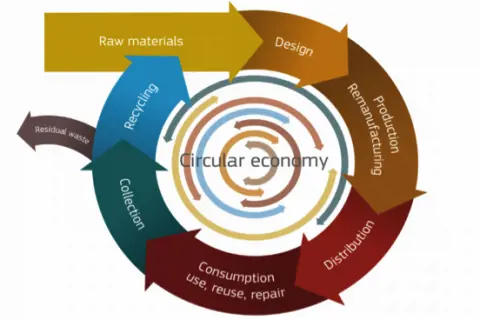
 The figures are immense, meaning that there has to be a great deal of hidden potential. When considering this we should ask ourselves - how can we make the whole lifecycle more efficient, reduce our production and consumption levels and bring some of the generated waste back into the life cycle? The new approach is called “Circular economy”, since more material can “be kept” in the circle of production and consumption.
The main objective of the circular economy is to make economic systems and industrial processes more environmentally friendly and sustainable. Shifting to a circular economy is not a straight forward process and requires substantial changes in the value chain, such as; adapted design, better waste and water management, greater recycling and re-use of products.
Waste: Tapping into unused potential – increasing resource efficiency
Based on analysis made by the EU two main kinds of potential for waste have been identified:
- Turning waste into a resource - only around 1/3 was recycled, and the rest incinerated or landfilled. Estimated additional potential for reuse / recycling is up to 600 million tons. If this material is lost then growth, job creation, and competitiveness will be compromised and negative environmental impacts generated. The main objective is to recycle more in order to have more „waste“ which can be used as a resource. Recycling is a pre-condition for the circular economy.
- Waste as a source of energy: When waste cannot be recycled then the potential energy it contains should be recovered in all its forms through; incineration, anaerobic digestion, and waste-derived fuels.
The key elements of the EU circular economy:
- A common EU target for recycling 65% of municipal waste, by 2030;
- A common EU target for recycling 75% of packaging waste, by 2030;
- Material-specific targets for different packaging materials;
- A binding landfill reduction target of 10%, by 2030.
When viewing the current figures a circular economy could have the following impact on our business in EU countries:
- An increase in separate collection
- From landfilling to incineration (energy recovery)
- Less incineration due to more recycling and reuse
- Waste prevention; lower waste streams expected in the future
Current status of the EU circular economy
Circular economy is now more and more frequently mentioned. However, it is important to be aware that there are two problems connected to this topic:
- The “legal” base is missing: Currently, there is an action plan which is still under discussion at the EU commission. Final recycling targets are still to be fixed, as well as the methods of calculation to be used. It will take some time until the action plan has been formally finalized by the EU and it will require more time to transfer the amended EU laws into national laws- However, we should remain prepared as these implementations are clearly approaching.
- The comparison of data from the different countries has not proved easy so far; with each EU country applying different methods for the counting of waste streams and the calculation of recycling targets, which has rendered the data from different countries more or less incomparable. One target of a circular economy is to harmonize these methods of definition and calculation.
FCC CEE Group and the circular economy
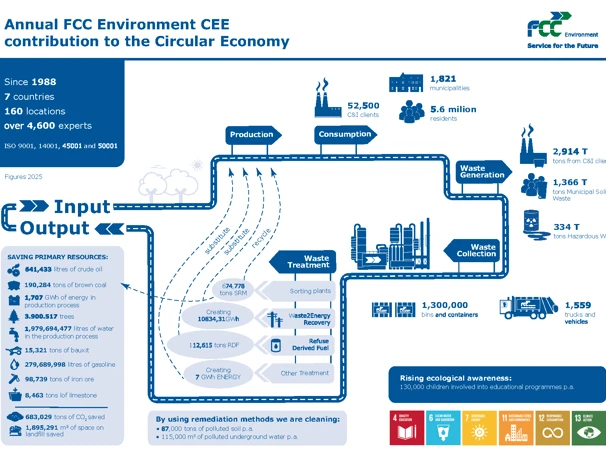
FCC CEE provides waste collection, transport, sorting, treatment, recovery, and disposal services in Central and South-Eastern Europe. The treatment method applied depends on the type and composition of the waste, available infrastructure, and applicable regulatory requirements.
According to FCC CEE’s internal operating data for 2025, the Group handled more than 670,000 tonnes of secondary raw materials. Collection yards, transfer stations, and sorting facilities separate suitable material fractions and prepare them for further processing.
FCC CEE also operates facilities that recover energy from suitable waste streams. According to internal operating data for 2025, the relevant facilities generated 192 GWh of energy. The figure covers the W2E plants.
At selected facilities, suitable high-calorific waste fractions are processed into refuse-derived fuel, or RDF, for use in authorised industrial installations, including cement and lime production. Any claim concerning the replacement of fossil fuels or associated emissions should specify the quantity of RDF used, the conventional fuel being replaced, the reporting period, and the calculation methodology.
Sources:
- http://www.worldometers.info/
- www.denkstatt.at
- http://www.fao.org/nr/water/aquastat/tables/WorldData-Withdrawal_eng.pdf
- http://siteresources.worldbank.org/INTURBANDEVELOPMENT/Resources/336387-1334852610766/Chap3.pdf
- https://ec.europa.eu/easme/en/news/r2-supporting-transition-circular-economy